
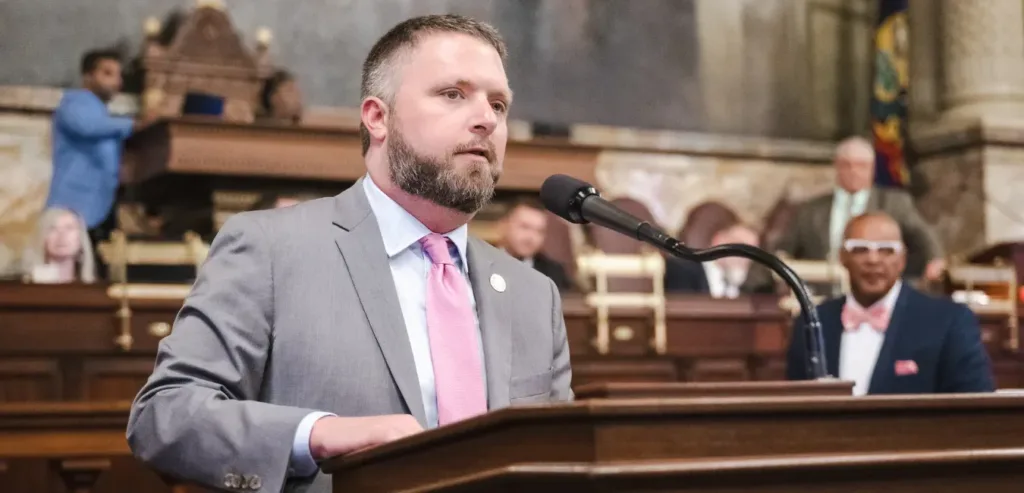
Rep. Ben Waxman: Ethics Matter For Public Trust in Government
When people believe the rules are rigged, trust in government collapses.
Public trust is difficult to build and easy to destroy. It disappears when elected officials appear to use public office to enrich themselves, their families, or their business partners. That is why ethics laws are not a side issue. They are essential to a functioning democracy.
New financial assets, particularly cryptocurrency, have created new opportunities for corruption and self-dealing. Our laws need to catch up.
I sponsored legislation addressing cryptocurrency corruption that recently passed the Pennsylvania House. But these protections are needed at every level of government.
Congress is now considering the CLARITY Act, legislation that would establish federal rules for the cryptocurrency industry. Yet the bill fails to address the most obvious ethical question: Should elected officials be allowed to profit from an industry while they are writing the laws that govern it?
The answer should be no.
The Trump family has developed a large and expanding financial interest in cryptocurrency through digital asset companies, token offerings, and related business partnerships. At the same time, the Trump administration and Congress are making decisions that could determine the future of the industry.
Whatever your opinion of cryptocurrency or Donald Trump, that is an obvious conflict of interest.
No president, member of Congress, cabinet official, or immediate family member should be able to make money from policies that person is responsible for writing, enforcing, or influencing. That standard should apply equally to Republicans and Democrats.
The risks are not theoretical. Before President Trump returned to office, a firm backed by the United Arab Emirates committed hundreds of millions of dollars to a cryptocurrency venture connected to the Trump family. The administration later relaxed restrictions involving the export of advanced artificial-intelligence technology to the UAE.
At a minimum, that sequence of events raises serious questions about whether American policy is being shaped by the national interest or by the private financial interests of people close to the president.
Congress should not ignore those questions.
The solution is straightforward. The CLARITY Act should prohibit elected officials, senior executive branch appointees, and their immediate family members from owning, issuing, promoting, or profiting from cryptocurrency ventures while those officials are in office.
These rules should be clear, enforceable, and applicable to everyone.
Pennsylvania’s senators have an important role to play. Senator John Fetterman has repeatedly presented himself as someone willing to challenge powerful interests on behalf of working people. He should insist that meaningful ethics protections be included before the Senate takes a final vote.
Without those protections, he should oppose the bill.
The issue is larger than cryptocurrency. It is whether Americans can trust that public officials are writing laws for the public rather than themselves.
Ethics cannot be an afterthought added after the industry gets what it wants. Ethics must be the foundation of the law.
Until Congress closes the door on self-dealing, the CLARITY Act is not ready to become law.
Rep. Ben Waxman represents the 182nd Legislative District in the Pennsylvania House of Representatives


