Almanac of American Politics: Pennsylvania
For more than five decades, the Almanac of American Politics has set the standard for political reference books. In September, the Almanac will be publishing its 2026 edition, with more than 2,000 pages offering fully updated chapters on all 435 House members and their districts, all 100 senators, all 50 states and governors, and much more.
Below are excerpts from the new chapters in the 2026 Almanac on the state of Pennsylvania and Gov. Josh Shapiro, written by Louis Jacobson. Jacobson — a senior correspondent for PolitiFact, a senior columnist for Sabato’s Crystal Ball at the University of Virginia Center for Politics, and a contributor of political coverage for U.S. News & World Report — has written for eight editions of the Almanac since 2000. For the 2026 edition, he served as chief author.
Readers can receive a 15% discount if they purchase the new Almanac at its website and use the code PoliticsPA2026 at checkout.
Pennsylvania has long been a state targeted by both Democrats and Republicans, with competitive contests at almost every level of government. As in the 2016 and 2020 presidential races, Pennsylvania in 2024 proved pivotal; it was the battleground prize with the most electoral votes. For the third straight election, Pennsylvania went with the winner, this time Donald Trump, and it handed a once Democratic Senate seat to the GOP.
Pennsylvania “sprawls from the Northeast corridor to Appalachia to the Midwest,” Jonathan Tamari wrote in the Philadelphia Inquirer. “It’s a place of big, crowded cities, affluent suburbs, and vast farmland. Cascading mountains, forested lakefronts, fracking wells, cul-de-sacs, corner stores, and gleaming skyscrapers. Sheetz and Wawa. World-class colleges and shuttered factories. Diverse, dynamic cities and huge rural stretches where the population is almost entirely white. Each piece is big enough that no one aspect dominates the rest.” Indeed, the combination of votes from Philadelphia, its collar suburbs, and Pittsburgh’s Allegheny County does not give the Democrats enough of a cushion to win the state comfortably; they also need to do well in other, far-flung parts of the state that have been consistently moving toward the Republicans.
The state in which the founders declared American independence and wrote the Constitution started as a Quaker haven, founded in 1682 by the pacifist William Penn, son of an admiral to whom King Charles II owed political debts. Pennsylvania’s policy of tolerance attracted Englishmen of many religious sects and thousands of pietist Germans – ancestors of the Pennsylvania Dutch. Soon, Pennsylvania became the major settlement in the middle colonies and Philadelphia the largest colonial port. In the 18th century, border men from Scotland, the north of England and Northern Ireland landed in Philadelphia and crossed the Appalachians’ corduroy ridges and settled the mountainous interior. The geometric lines William Penn had obtained from the king included two major river systems – the wide Delaware estuary with its thriving commerce and rich hinterland, and the golden triangle where the Allegheny and Monongahela Rivers joined to form the Ohio. They remain important geographical features defining the state’s eastern and western regions. Philadelphia was the natural host for the Continental Congresses that began meeting in 1774, and in the early republic, the city seemed destined to become the London of America, the metropolis of government, commerce and culture. Pittsburgh, founded in 1758, was the young republic’s key frontier metropolis, the fulcrum of American expansion.
But Philadelphia – and Pennsylvania – failed to maintain the central position the nation’s founders expected. As part of a political deal, the young republic’s capital was put about 80 miles south of the Mason-Dixon line, along the Potomac River. And the Erie Canal from the Hudson River to Lake Erie, completed in 1825, channeled trade away from Philadelphia to New York. Pennsylvania evolved into America’s early capital of energy and heavy industry. Northeast Pennsylvania was the nation’s primary source of anthracite, the hard coal used to heat homes, and western Pennsylvania was laced with bituminous coal, the soft coal used to make steel. Pittsburgh, connected to Philadelphia by the Pennsylvania Railroad, was the center of the nation’s steel industry by 1890; it became synonymous with industrial prosperity and, led by its adopted son, steel magnate Andrew Carnegie, for philanthropy.. Immigrants poured in from Europe and from the surrounding hills to work in western Pennsylvania’s hardscrabble mines and factories. Today, Pennsylvania’s Catholic population is estimated to be about 1 of every 4 adults.
Pennsylvania was the nation’s second-largest state from the first census in 1790 through 1940. It stopped growing rapidly during the Great Depression, and in some parts of the state growth has never returned. After World War II, home heating and industry shifted away from coal. Only the embers remain, or the fires: The Red Ash colliery fire, ignited in 1915, burns on beneath the hills above Wilkes-Barre, as do a few dozen other fires in abandoned coal mines. Similarly, Pennsylvania steel began a sharp decline in the 1960s. The result has been the slowest population growth of any major state. Pennsylvania cast 36 electoral votes for Franklin Roosevelt in 1940, but 19 for Donald Trump in 2024. In 1960, Pennsylvania had 30 House members, as many as California and more than Texas. Now it has 17 to California’s 52 and Texas’ 38.
Since 2010, Pennsylvania has grown about 3 percent; in 2023, it was one of eight states to lose population. (A consolation prize was that Pennsylvania in 2017 regained fifth place among most populous states, surpassing Illinois.) Some pockets have expanded more than others: Since the 2010 census, Cumberland County (Harrisburg suburbs and Carlisle) grew 17 percent, Lebanon County (east of Harrisburg) grew 8.8 percent, Lehigh County (Allentown-Bethlehem) grew 10.3 percent, and Lancaster County (Lancaster) grew 8.4 percent, while two of Philadelphia’s collar counties, Montgomery and Chester, each grew by 10 to 12 percent. But other corners of the state have either barely increased, such as Lackawanna County (Scranton) and Luzerne County (Wilkes-Barre) in the northeast, or shrunk slightly, including Erie County (Erie) in the northwest. With relatively few outsiders moving in, Pennsylvania has become increasingly aged – it ranks 10th highest in the percentage of residents age 65 and older. Pennsylvania also remains one of the whitest big states – it’s 12.3 percent Black, 8.9 percent Hispanic, and 4.2 percent Asian. Some parts of the state, however, have seen rapid Hispanic increases, notably Hazleton in Luzerne County, now 63 percent Hispanic – a shift that at first prompted bitter battles over immigration. Hispanics from New York and North Jersey, many of them Puerto Rican and Dominican, have followed Interstate 78 to Reading (now 69 percent Hispanic), Allentown (54 percent Hispanic) and Bethlehem (almost 30 percent Hispanic).
Economically, Pennsylvania has begun to perk up over the past two decades. A $6 billion “ethane cracker” plant opened in Monaca in 2022, though as that project was being built, U.S. Steel pulled the plug on a $1 billion upgrade for its Mon Valley Works near Pittsburgh. (The cracker plant has prompted environmental complaints locally, and in 2023, it was fined $10 million for air quality violations.) In metro Pittsburgh, big hospitals have replaced big steel mills as leading employers. Economic growth has diversified in Philadelphia, its suburbs and the surrounding countryside. The Lehigh Valley, meanwhile, has capitalized on its convenient access to transportation routes to lure warehouse jobs. Manufacturing remains important outside the big cities, but manufacturing employment in Pennsylvania has fallen by 35 percent since 2000, compared with the nation’s 26 percent drop. Pennsylvania has held state taxes down more than many of its Northeastern neighbors, which has lured New Yorkers to retire near the Delaware Water Gap and the Poconos. Meanwhile, both Philadelphia and Pittsburgh have become hip destinations with cultural and nightlife amenities. Although the number of farms has fallen, agriculture remains a significant Pennsylvania industry; the state ranks in the top five nationally for producing pumpkins, apples, peaches and eggs, and seventh in milk. Pennsylvania also ranks first nationally in mushroom production, centered on Kennett Square in Chester County, “the Mushroom Capital of the World.”
James Carville once famously described the state as Pittsburgh and Philadelphia with Alabama in between. Those parts in the “T” of rural Pennsylvania were the sites of the world’s first oil well, near Titusville, and first commercial nuclear power plant, in Shippingport. More recently, this region has benefited from the Marcellus Shale that lies beneath 60 percent of Pennsylvania and much of upstate New York. The Marcellus Shale contains the nation’s largest reserves of natural gas embedded in hard rock; these reserves can be surfaced by hydraulic fracturing, or fracking. Pennsylvania has become the second-largest producer of natural gas after Texas, with 20 percent of U.S. output, economically transforming portions of the state’s southwest, though worries remain about pollution and a record of heavy indebtedness by some extractors. Philadelphia, meanwhile, has its challenges: In 2021 and 2022, the number of murders in Philadelphia was about twice its level in 2016, and Republican legislators sought to impeach progressive Philadelphia District Attorney Larry Krasner for deemphasizing the prosecution of some lower-level crimes, but the courts blocked those moves. Since then, crime in the city has eased. Meanwhile, Pennsylvania is one of only two Northeastern states in which the median income is less than the national average; the other is Maine.
For generations after the Civil War—whose turning point is often pegged to quiet Gettysburg – Pennsylvania was the most Republican of the large states, partly because of the legacy of Abraham Lincoln and the Union, and partly because of the steel industry and high tariffs. The state’s Republican machines built parties that represented not one ethnic segment, but could accommodate just about everyone. In 1932, Pennsylvania was the only big state that stuck with Republican Herbert Hoover over Democrat Franklin Roosevelt. Then, the political landscape changed. The New Deal, John L. Lewis’ United Mine Workers, the Congress of Industrial Organizations industrial union movement, and a series of bloody strikes made industrial Pennsylvania Democratic. Even then, parts of Pennsylvania that weren’t heavy with big steel factories and coal mines – the northern tier of counties along the New York border, the central part of the state around Altoona and the Pennsylvania Dutch country around Lancaster – remained among the East’s strongest Republican voting blocs. Philadelphia became heavily Democratic after the last Republican mayor left office in 1952, but in the suburban counties, the old Republican machines remained.
In the 1980s, prosperous eastern Pennsylvania was trending Republican as ailing western Pennsylvania was trending Democratic. By the 1990s, though, the pattern began to reverse. Fiscally conservative but socially moderate suburban Republicans in the state’s east increasingly voted for Democrats; economically liberal but socially conservative Democrats in the west flocked to the GOP. Pennsylvania voted Republican for president three times in the 1980s but Democratic for president in 1992 and the subsequent five elections. But western Pennsylvania, other than Pittsburgh’s increasingly blue Allegheny County, has moved in the other direction, with voters strongly supporting socially conservative policies, gun rights and energy drilling. In four heavily working-class counties surrounding Allegheny – Beaver, Fayette, Greene and Washington – Al Gore won better than 53 percent of the two-party vote in 2000, but by 2024, each gave Kamala Harris 26 percent to 39 percent, PoliticsPA noted. Demographically similar areas of the state echoed these shifts. The silver lining for Democrats was a major improvement in Philadelphia’s suburban collar counties. To gauge how Pennsylvania’s political winds are blowing, you could look at Erie County, which has become the swingiest county in one of the swingiest states in the nation: Since 2008, it has voted with the winner in 27 of Pennsylvania’s 30 nonjudicial statewide elections.
In 2020, Joe Biden did well enough to reverse Trump’s 2016 margin, and a bit more, by gaining incrementally almost everywhere. The race was close enough that Trump and his allies tried to overturn Biden’s victory through lawsuits, entreaties to state legislative leaders (which were rebuffed) and a mystifying press conference by Trump’s lawyer, Rudy Giuliani, at Four Seasons Total Landscaping in Philadelphia. Democrats performed well in the 2022 midterms, with Josh Shapiro and John Fetterman winning the governorship and a U.S. Senate seat against MAGA-aligned GOP candidates and winning just enough seats to take control of the state House for the first time in a decade and a half.
But Republicans flipped the script in 2024, when Trump’s presence on the ballot energized lower-propensity voters, enabling a win by about 120,000 votes – nearly 40,000 votes more than Biden won by in 2020. Republican primary electorates cooperated by nominating more mainstream candidates, including former hedge fund executive Dave McCormick; he did what Republicans in other battleground states failed to do – flip a Democratic Senate seat, in this case, the one Bob Casey held. Republicans also flipped two U.S. House seats in the northeast region and returned vulnerable Rep. Scott Perry to Congress. Meanwhile, the GOP swept races for attorney general, auditor and treasurer. The main consolation for Democrats was holding the narrowly divided state House as Republicans were retaining the state Senate. A key battle for 2026: Democrats will look to protect their majority on the state Supreme Court by defending three incumbents.
After a steady rise through Pennsylvania politics, Josh Shapiro was elected governor in 2022. In office, Shapiro earned plaudits for leading a rapid recovery from a bridge collapse in Philadelphia and was the runner-up in the race to join Kamala Harris on the 2024 Democratic presidential ticket. Shapiro, a pragmatic voice within the Democratic Party, has rhetorical skills and is considered a formidable contender for the presidency one day.
Shapiro was born in Kansas City Missouri and grew up in suburban Philadelphia; his father was a pediatrician; and his mother was a teacher. In middle school, Shapiro forged a pen-pal relationship with Avi Goldstein, a Jewish refusenik in the Soviet Union; Goldstein managed to immigrate to the United States in time to attend Shapiro’s bar mitzvah. Shapiro lost his first bid for office, in which he ran for student president at Akiba Hebrew Academy; it remains his only loss to date. (Shapiro also met his future wife, Lori, at the school.) Shapiro attended the University of Rochester in New York state, where he made the basketball team but focused instead on student government, winning the student presidency. After graduation, Shapiro worked as a Capitol Hill aide for Rep. Joe Hoeffel of Pennsylvania and Sen. Robert Torricelli of New Jersey, both Democrats, while earning a law degree from Georgetown University.
In 2004, Shapiro, then 31, ousted Republican state Rep. Jon Fox, a former congressman. In his second term, Shapiro gained notice for negotiating a deal that broke a deadlock in the narrowly divided chamber, enabling the election of a moderate Republican to succeed the scandal-tinged incumbent GOP speaker, John Perzel; as part of the deal, Shapiro became deputy speaker. Shapiro later urged a Democratic powerbroker, Bill DeWeese, to step down. In 2011, Shapiro ran for and won a seat on the commission governing Montgomery County, an affluent and increasingly blue suburb of Philadelphia; his victory sealed the Democratic takeover of the commission, which Republicans had long controlled. In 2016, Shapiro won a race for attorney general; he was reelected in 2020. As attorney general, Shapiro helped settle a long-running dispute between Highmark and UPMC, two of the state’s leading health care companies, and he secured a $1 billion opioid settlement. Shapiro’s most widely noticed action, not just in Pennsylvania but also nationally, was a report on child sex abuse within the Catholic Church. After the 2020 election, Shapiro went to court to defend the state’s election system, which Donald Trump had challenged.
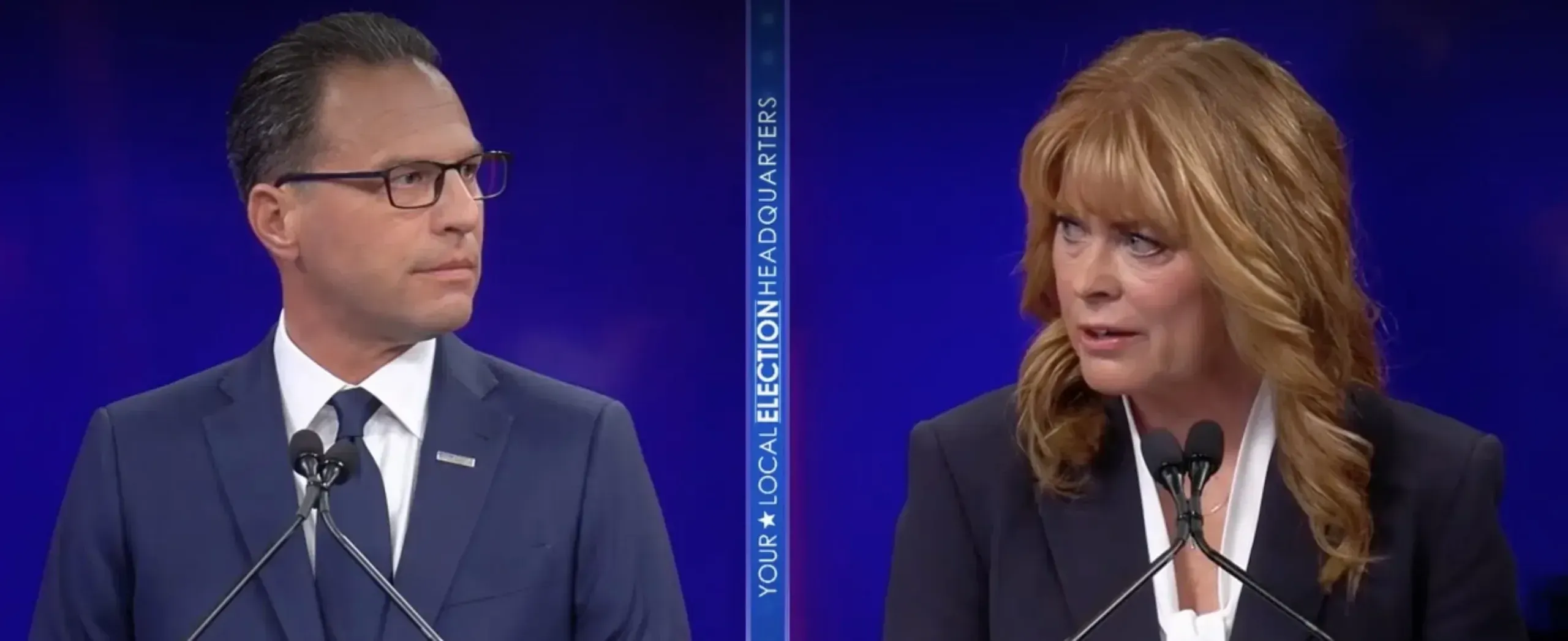
In 2022, Democratic Gov. Tom Wolf was term-limited, and in the race to succeed him, Shapiro had the stature to stave off other serious Democratic contenders. The Republican primary was messier. For the first time in decades, the state party made no endorsement in the contest, and this attracted a large field of contenders. State Sen. Doug Mastriano, who worked to overturn the 2020 election and sent buses to the Jan. 6 protests at the Capitol, had a strong base of support within the primary electorate, and Republicans who felt he would be a less-than-ideal general election candidate regretted not working to narrow the field earlier in the race. Belatedly, state Senate leader Jake Corman and former Rep. Melissa Hart left the race, hoping to shift anti-Mastriano voters to former Rep. Lou Barletta. But some voters had already cast their ballots by then, and Mastriano was benefiting from a Shapiro-backed ad slamming him for his ties to Trump, which reinforced his bona fides among many GOP primary voters. Mastriano won the primary with 44 percent.
With Mastriano’s win, national Republicans became less interested in the gubernatorial race, focusing instead on the highly competitive open-seat Senate contest between Democratic Lt. Gov. John Fetterman and Republican heart surgeon and TV personality Mehmet Oz. Shapiro ran a generally moderate campaign; bucking the Democrats’ progressive wing, he supported hydraulic fracturing, or fracking, as part of the state’s energy agenda, urged the hiring of more police officers, and proposed a lower corporate net income tax. Shapiro energized his own base by warning that as governor, Mastriano and the GOP-held Legislature would be empowered to enact strong anti-abortion policies. Shapiro also raised the specter of Mastriano wielding power over the state’s election system. Mastriano, meanwhile, criticized Shapiro for sending his children to “one of the most privileged, entitled schools in the nation,” which happened to be a Jewish day school. Mastriano, trailing in money, irritated even Republican figures across the state with his low-profile campaign appearances, which eschewed mainstream media coverage and focused only on his strongest supporters.
Shapiro won, 56%-42%, capturing four counties Joe Biden had failed to win two years earlier: Beaver (an industrial region north of Pittsburgh), Cumberland (Carlisle and the Harrisburg suburbs), Luzerne (Wilkes-Barre), and Berks (Reading). Democrats also won narrow control of the state House, although Republicans retained the Senate. For his inauguration, Shapiro was sworn in on a Hebrew Bible from the Tree of Life synagogue, the site of a 2018 mass shooting in Pittsburgh, and a Bible a Jewish soldier from Pennsylvania had used during World War II. But Shapiro did not become Pennsylvania’s first Jewish governor; he was preceded by Milton Shapp in the 1970s and Ed Rendell in the 2000s.
In office, Shapiro issued an executive order opening state government jobs to applicants who lack bachelor’s degrees. Shapiro tapped Al Schmidt, a Philadelphia Republican, as secretary of state. Trump allies had targeted Schmidt for defending the city’s voting process following the 2020 election. Shapiro’s first major challenge came in June 2023, when a gasoline tanker under an overpass caught fire, causing a structural collapse that severed heavily trafficked Interstate 95 in northeast Philadelphia. Defying expectations that it would take months to reopen the highway, Shapiro, backed by federal dollars, signed an emergency declaration and spearheaded a repair project that opened six new temporary lanes in less than two weeks. “We all came together and proved that we can do big things again in Pennsylvania,” Shapiro said.
On other priorities, the GOP-controlled Senate and a narrow Democratic majority (sometimes hobbled by vacancies) in the state House stymied Shapiro. But he did enact automatic voter registration and shutter a three-decade program of state funding for anti-abortion counseling centers. In 2024, Shapiro took a more critical line than some national Democrats in opposing anti-Israel protesters on college campuses. “Our colleges, in many cases, are failing young people,” he said. “Failing to teach information that is necessary to form thoughtful perspectives. They are willing to let certain forms of hate pass by and condemn others more strongly.”
For Shapiro, the 2024 presidential campaign was a whirlwind. After a would-be assassin tried to kill Trump in Butler, Pennsylvania, on July 13, Shapiro became a key figure in releasing information from law enforcement, and he called the family of Corey Comperatore, the Trump supporter who was killed in the shooting and whose family declined to take a call from Biden. When Biden quit the Democratic presidential race and endorsed Harris to succeed him about a week later, Shapiro surged to the top of the list of her potential running mates, a nod to his political standing, to his potential appeal to swing voters nationally and, perhaps most important, to Pennsylvania’s role as the battleground state with the most electoral votes. As Harris was considering her choice, Sen. JD Vance, Trump’s newly chosen running mate, said in a podcast that Shapiro “talks like Barack Obama,” which Vance described as “a bad impression” but which Shapiro and others took as a backhanded compliment of his oratory. Ultimately, Shapiro was beat out by Minnesota Gov. Tim Walz; some reporting suggested that Shapiro would have chafed in the No. 2 slot. (In a sign of a burgeoning intra-Democratic Party feud, Fetterman, who’d become senator, conspicuously expressed little emotion during Shapiro’s speech at an otherwise animated Philadelphia rally in which Harris unveiled Walz as her pick.) After Harris lost the presidential race and Pennsylvania to Trump, and the Democrats lost a Pennsylvania Senate seat they’d held, observers mulled whether Shapiro would have been a better vice presidential pick after all.
Voters in 2024 also elected a Republican as state attorney general, the first time the state’s AG and governor have been occupied by different parties in a decade. Democrats failed to flip the state Senate, and the state House remained closely divided, portending another challenging legislative year for Shapiro.
In April 2025, Shapiro and his family were evacuated from the governor’s mansion when a man trespassed and started a blaze that charred a sizable portion of the home. A suspect was charged with attempted murder and arson.